There comes a point in every wood-burning bread oven installation when you stand back, look at what you have built, and convince yourself the worst is over. The oven was finally sitting on top of its new metal frame, exactly where we had spent far too much time, energy, and questionable engineering getting it. After dismantling it, moving it through the house, rebuilding it, fabricating a support frame, and recruiting the Blue Monster to lift the roughly 500-pound beast into place, the sensible thing would have been to declare victory.
But it still looked like an oven sitting on a metal frame.
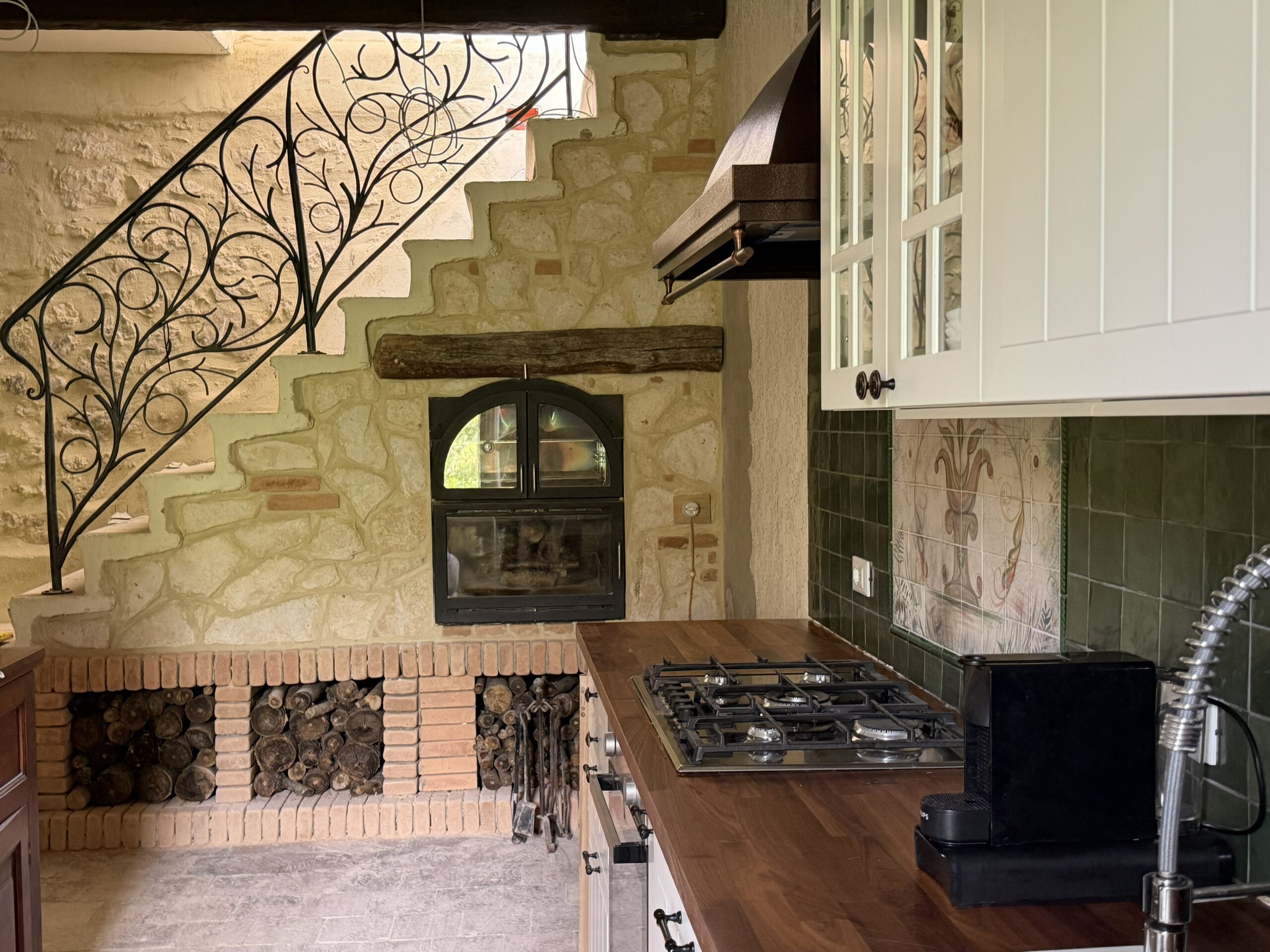
The rest of the kitchen had old limestone walls, thick, imperfect things that had been standing there long before we arrived. Some are close to a meter thick. I wanted the new wall around the oven to look like it belonged with them, but I had absolutely no intention of building another meter-thick limestone wall. We had already moved enough stone and heavy machinery through this house to satisfy whatever punishment the restoration gods thought we deserved.
What I needed was a convincing fake.
Making a New Wall Look Old
The plan was to find limestone similar to the original stone but much thinner, something that could be attached to the outside of the new wall as a veneer. Structurally, it would be nothing like the old walls. Visually, however, it could mimic them well enough that the oven wouldn’t look like a modern object we had bullied into an ancient house.
Eventually we found a similar light limestone that worked. The difference was obvious from a construction standpoint. The original walls are massive pieces of the house itself, while this would simply be a thin stone facing. But I wasn’t trying to manufacture history. I just wanted the new work to stop fighting with everything around it.
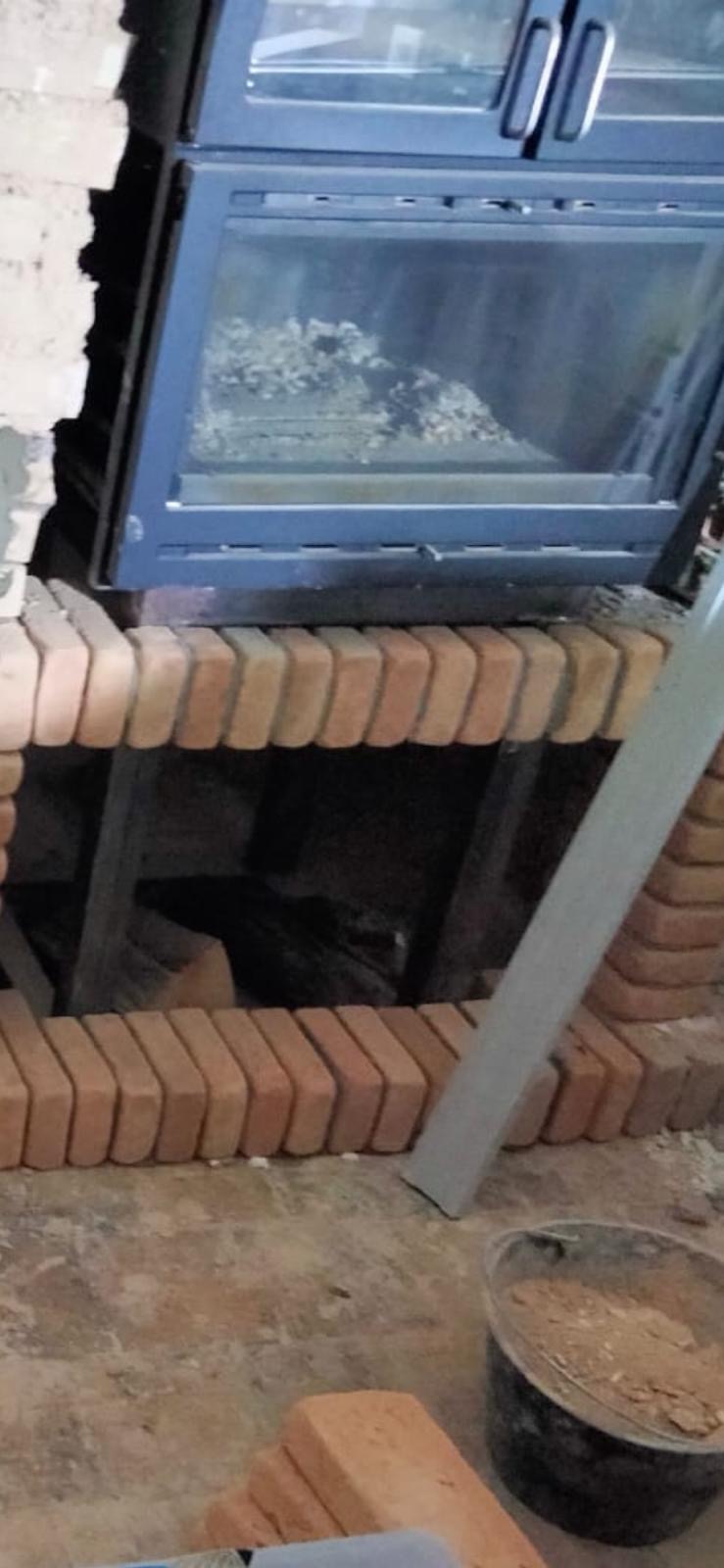
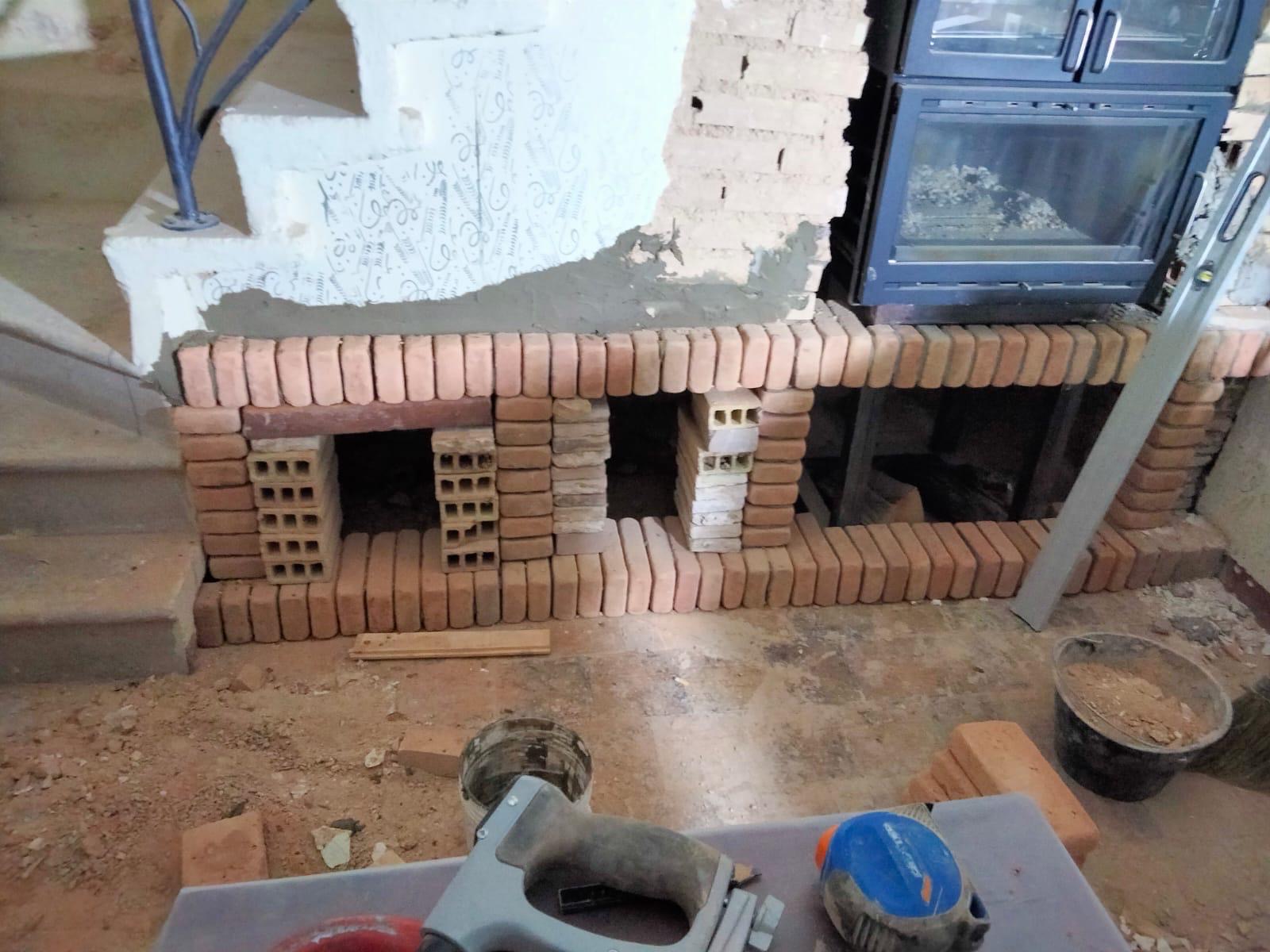
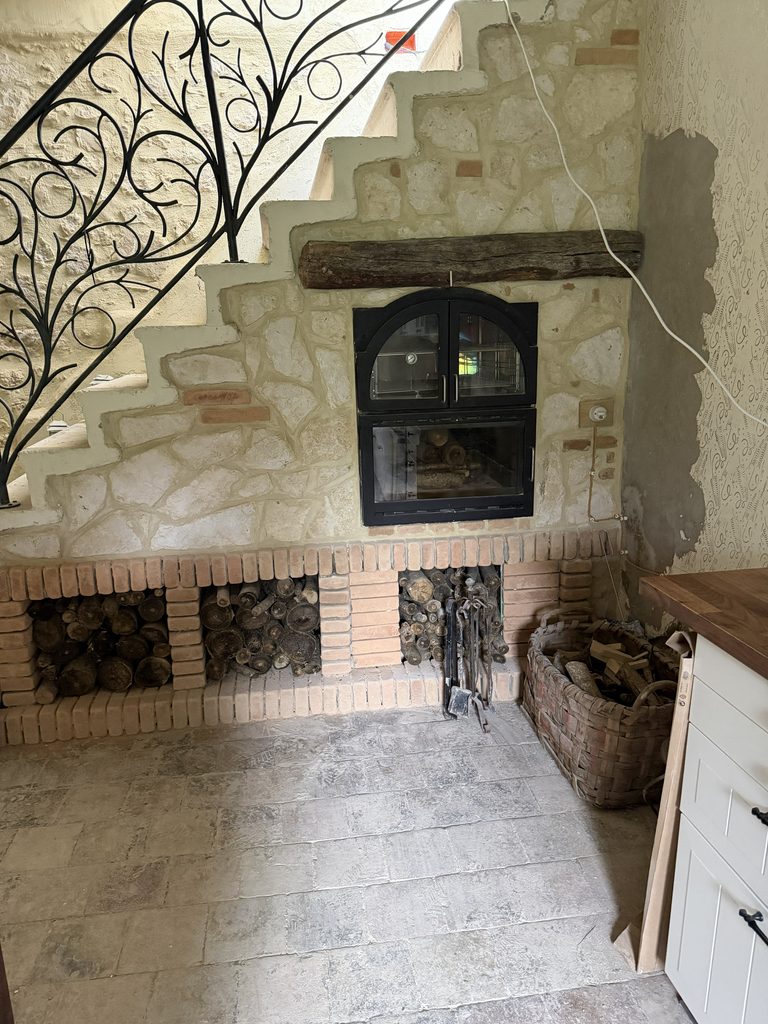
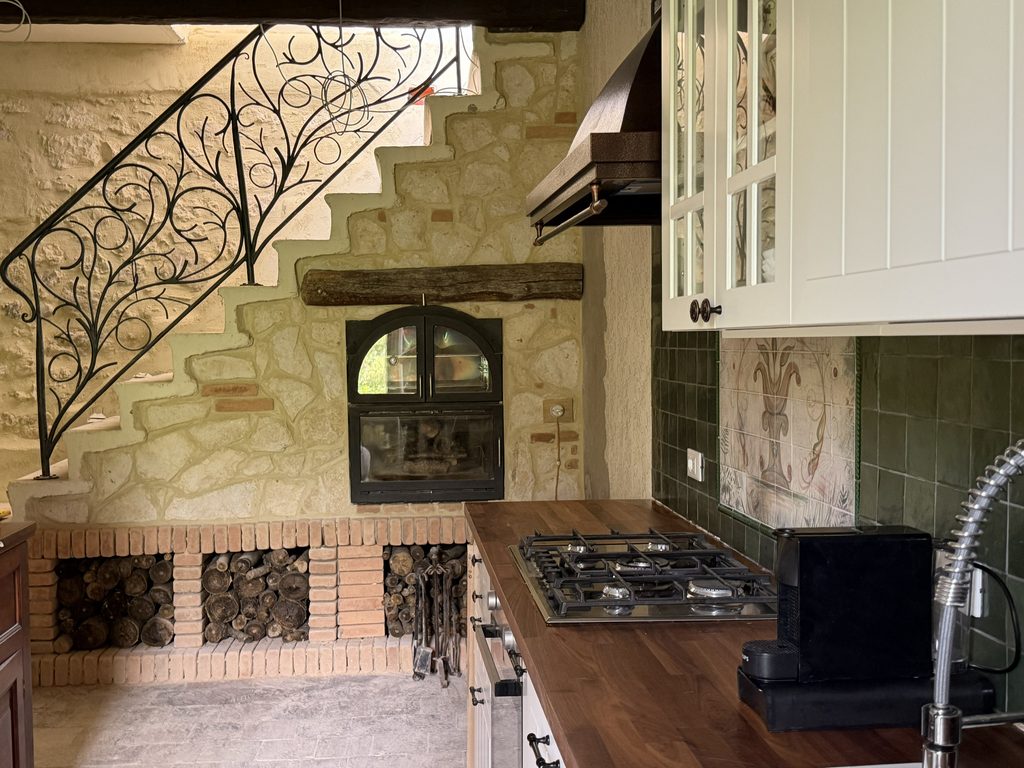
At the bottom, I built a brick-framed opening where we could store firewood. This immediately led to a recurring conversation with the town handyman.
Why no doors?
I explained that I liked seeing the stacked firewood beneath the oven. There is something honest about it. A wood-burning oven with the wood sitting underneath doesn’t need much decoration or explanation. But aesthetics were only half the answer.
I also wanted those openings large enough for me to crawl through.
The obvious question is why. What exactly did I expect to go wrong behind the oven?
I didn’t have an answer. I still don’t.
But after everything involved in getting this oven installed, I had developed the firm belief that the moment I permanently closed that space, something behind it would fail. The universe would wait until the mortar dried, give me perhaps a day to admire my work, and then reveal some critical problem accessible only by breaking apart the wall I had just finished.
So there would be no doors.
As it turned out, paranoia was about to become preventive maintenance.
My Comfortable Little Torture Chamber
The space behind the oven is extremely tight. Getting into it involves squeezing through the opening and arranging your body according to whatever small amount of space the oven has decided to give you. Once inside, there isn’t enough room to turn around properly, and normal concepts such as comfortable movement and personal dignity cease to have much relevance.
There are screw heads and rivets waiting to grab your jacket. You move a few inches forward and one catches you. You try to back out and another one takes over. Somewhere during the process, a piece of metal usually finds the exact soft part of your stomach and gives you the traditional jab that makes you question every decision that led to owning a house in Italy. The lack of air adds atmosphere.
Over time, I had become strangely familiar with the place. It was my own comfortable little Scavenger’s Daughter, except instead of being stretched apart I was compressed between steel, stone, and a bread oven. Closing the openings would mean losing access to all of this. No more getting trapped by my jacket. No more trying to work with my arms in positions apparently not anticipated by human anatomy. No more wondering how I was going to reverse myself out of there.
Those are memories. Painful, claustrophobic memories, but memories nonetheless.
Fortunately, the oven soon gave me a legitimate reason to return.
The Mystery Cable
The top of the oven is designed for cooking, and it also has a light. At the time, however, all I knew was that a cable came out of the oven and needed to be connected.
My first thought was that it operated some kind of automatic exhaust fan. That seemed logical enough. Fire, smoke, heat, ventilation, mysterious electrical cable. Exhaust fan.
There was only one way to find out.
I connected it temporarily to an outlet, which meant another journey into the luxurious accommodations behind the oven. Once everything was connected, I applied power and waited to see what happened.
A light came on.
And stayed on.
No fan started. Nothing began exhausting. There was simply a light shining continuously.
Hint: it was a light.
Not an exhaust fan.
This was useful information, but now I had another job. A light permanently connected to power wasn’t particularly useful unless we wanted to illuminate the oven twenty-four hours a day. I needed to install a switch, which meant going back into the confined space behind the oven and changing the wiring.
This is precisely why I had refused to close the openings.
And while I was back there, I discovered something that justified the decision far sooner than expected.
What Could Possibly Go Wrong?
My significant other burns firewood with enthusiasm.
Actually, enthusiasm may be understating it. She seems to approach firewood as though she has entered a competition where the winner is whoever can deplete a forest first. Apparently, at some point she had taken a commanding lead.
When I crawled behind the oven to deal with the light wiring, I discovered that the electrical box I had installed back there had melted from the heat.
It looked like a wax candle.
This was one of those renovation moments that requires no commentary. I had repeatedly been asked why I wasn’t putting doors on the openings. I had repeatedly explained that I wanted permanent access because someday something might go wrong behind the oven.
Someday had arrived remarkably quickly.
So yes, things can happen back there, and I would need continued access to my comfortable little medieval torture device. The openings were staying open. The firewood would remain visible. And if anyone asked me again why there were no doors, I now had physical evidence.
Making Electricity Look Like It Belongs in an Old House
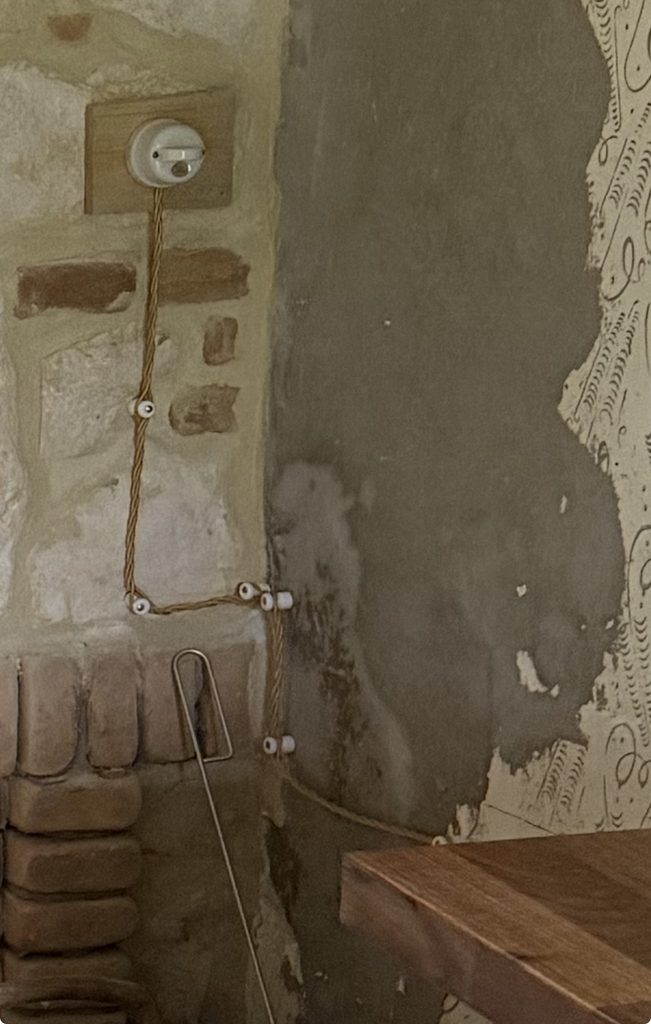
Since I had to install a proper switch for the oven light anyway, I decided I didn’t want a modern plastic switch and concealed wiring sitting against the limestone. It would work, but it would look completely disconnected from everything we were trying to accomplish with the room.
Instead, I chose an old-style ceramic rotary switch and ceramic/porcelain cable insulators so the wiring could remain exposed.
They look fantastic.
They are also not particularly budget friendly.
There seems to be an unwritten rule in restoration that anything made to look old, simple, and technologically primitive will cost considerably more than the modern version that does the same job. A ceramic switch is essentially an object whose entire purpose is to turn a light on and off, but apparently doing that while looking appropriate in an old Italian house comes at a premium.
It also took me a while to figure out exactly how I wanted the exposed cable to run along the wall. On paper, the concept is simple: switch, wire, porcelain insulators, light. On the actual wall, every change in direction suddenly becomes something you stare at for twenty minutes while deciding whether it looks intentional or like you simply didn’t know what you were doing.
Eventually, everything came together. The ceramic switch and porcelain insulators worked with the limestone instead of competing against it, and the exposed wiring became part of the design rather than something we needed to hide.
The switch itself still isn’t completely finished. I need to find the right backing plate for it, something that works with the ceramic switch and the rest of the old-style electrical installation. For now, I cut a simple piece of wood and mounted the switch to that. It does the job, but it is temporary. Once I find the right backing plate and the rest of the wall is painted, the whole thing should finally look the way I have it in my head.
Assuming, of course, the thing in my head actually exists somewhere for sale.
Stone, Old Wood, and a Wall That Finally Made Sense
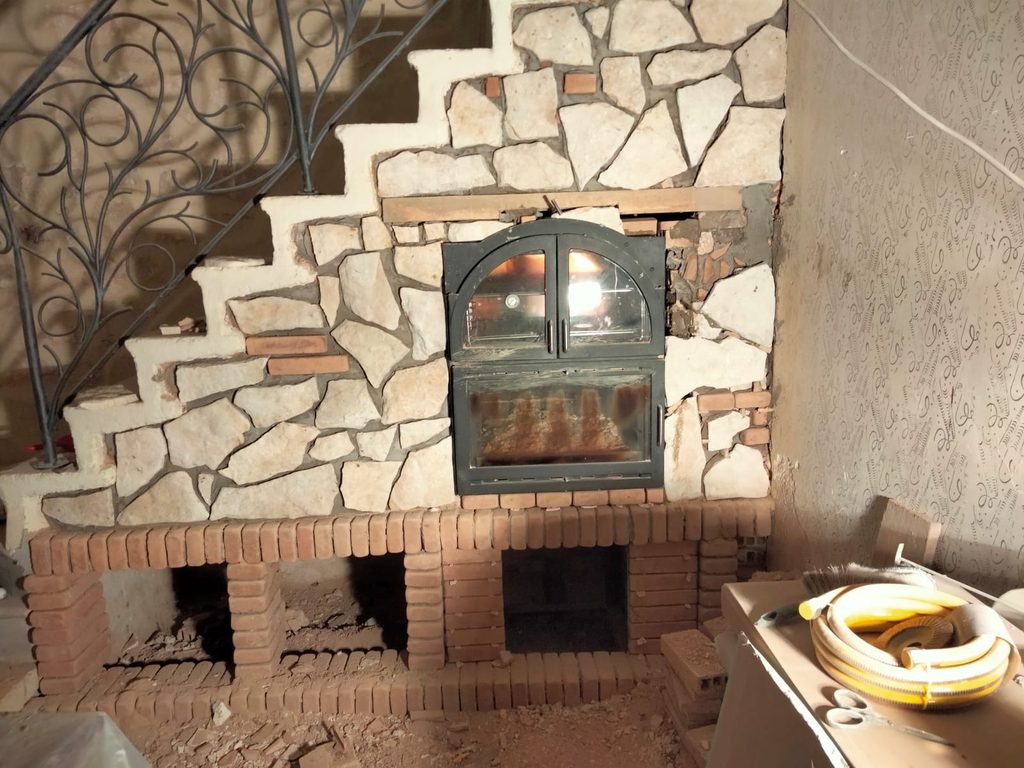
With the electrical problem handled, I could finish tying the oven into the kitchen. We covered the rest of the wall with the thin limestone we had found, giving the new construction the same general appearance as the old stone without pretending that we had somehow built another massive original wall.
I also had a piece of wood that I had been saving for this.
It was a section of log that had already been cut lengthwise and was heavily weathered, rough and full of old woodworm holes. It had spent about a year outside, which only improved its appearance. Every time we returned to the house, I covered it with mineral spirits because the charming little holes were one thing. Bringing a living population of woodworms inside and providing them with a historic Italian house as their next meal was another.
The imperfections were exactly why I wanted the piece. New lumber would have looked too clean, too straight, too recently purchased. This house has spent centuries accumulating irregularities, scars, repairs, stains, holes and evidence of people who came before us. Putting a perfectly milled piece of timber next to the limestone would have felt wrong.
The weathered wood helped visually tie everything together. The limestone, brick, old timber, exposed porcelain wiring, ceramic switch, black oven and stacked firewood finally began to look like parts of the same kitchen rather than individual projects completed at different times.
For the first time since this entire oven saga began, I could stand back and look at it without immediately seeing another major problem that needed to be solved.
That is a dangerous feeling.
The Blue Monster Goes Back Down
There was, however, still one large piece of unfinished business occupying the kitchen.
The Blue Monster.
In Part 2, the Blue Monster had been our solution to the rather significant problem of lifting the roughly 500-pound oven high enough to get it onto the metal frame. Getting the machine into the kitchen had been its own adventure. We had dismantled it, carried the pieces up, reassembled it, and used it to do the job that none of us were particularly interested in attempting with muscle, optimism, and an emergency-room visit waiting at the end.
Now the oven was secure and the Blue Monster had completed its mission.
Which meant we got to dismantle the entire thing again.
Piece by piece, it came apart. Everything we had carried upstairs now had to go back downstairs. There is something uniquely satisfying about spending considerable effort moving an enormous machine into a room, using it once, and then immediately spending considerable effort removing it from the room.
Eventually, all the pieces made their way back down to the animal grotto, where the Blue Monster will wait for future use.
I am keeping it.
After everything this house has shown us, getting rid of a machine capable of lifting something obscenely heavy would be tempting fate in a way even I am not prepared to attempt.
Hopefully, This Is the End of the Oven Saga
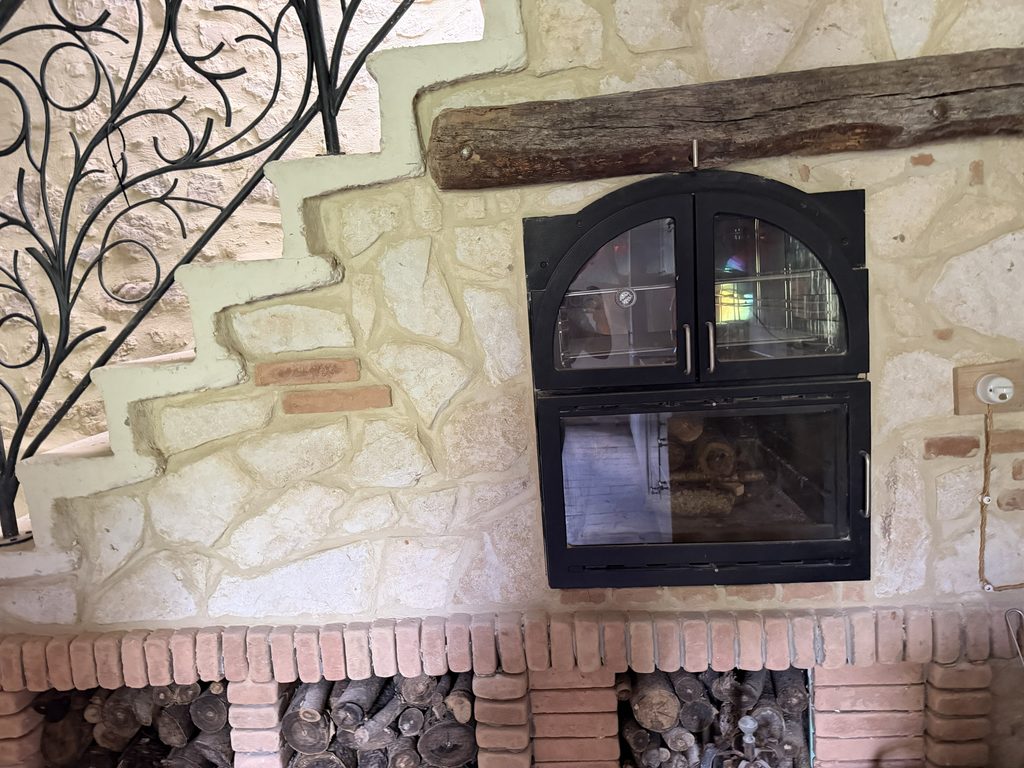
The oven began as something that simply needed to be installed. That innocent description eventually involved dismantling, moving, rebuilding, steel fabrication, heavy lifting equipment, limestone, brickwork, electrical wiring, porcelain insulators, a mysterious cable, a melted electrical box, firewood, an old piece of worm-eaten timber and repeated journeys into a space behind the oven where jackets go to die.
But now it finally looks like it belongs there.
The new wall isn’t a meter thick like the original limestone walls, and it isn’t pretending to be. It is a modern solution designed to visually connect the oven to an old house. The brick opening below gives us a place for firewood and, perhaps more importantly, keeps my escape route into the back of the oven permanently available. The old timber brings some genuine age and imperfection to the new work, and the ceramic switch and porcelain wiring add a detail that feels far more appropriate than modern plastic would have.
The Blue Monster is back in the grotto. The oven is in place. The light now has a switch, even if its proper backing plate is still somewhere out there waiting to be found. And the melted electrical box has already taught us an important lesson about what happens when my significant other decides the fire needs just one more piece of wood.
So this is hopefully the last chapter of the oven installation.
I use the word “hopefully” carefully.
This house has developed a habit of hearing declarations like “finished” and treating them as a personal challenge.
If you want to see what we repair, rebuild, discover, or accidentally melt next, follow the restoration and subscribe for the next chapter.