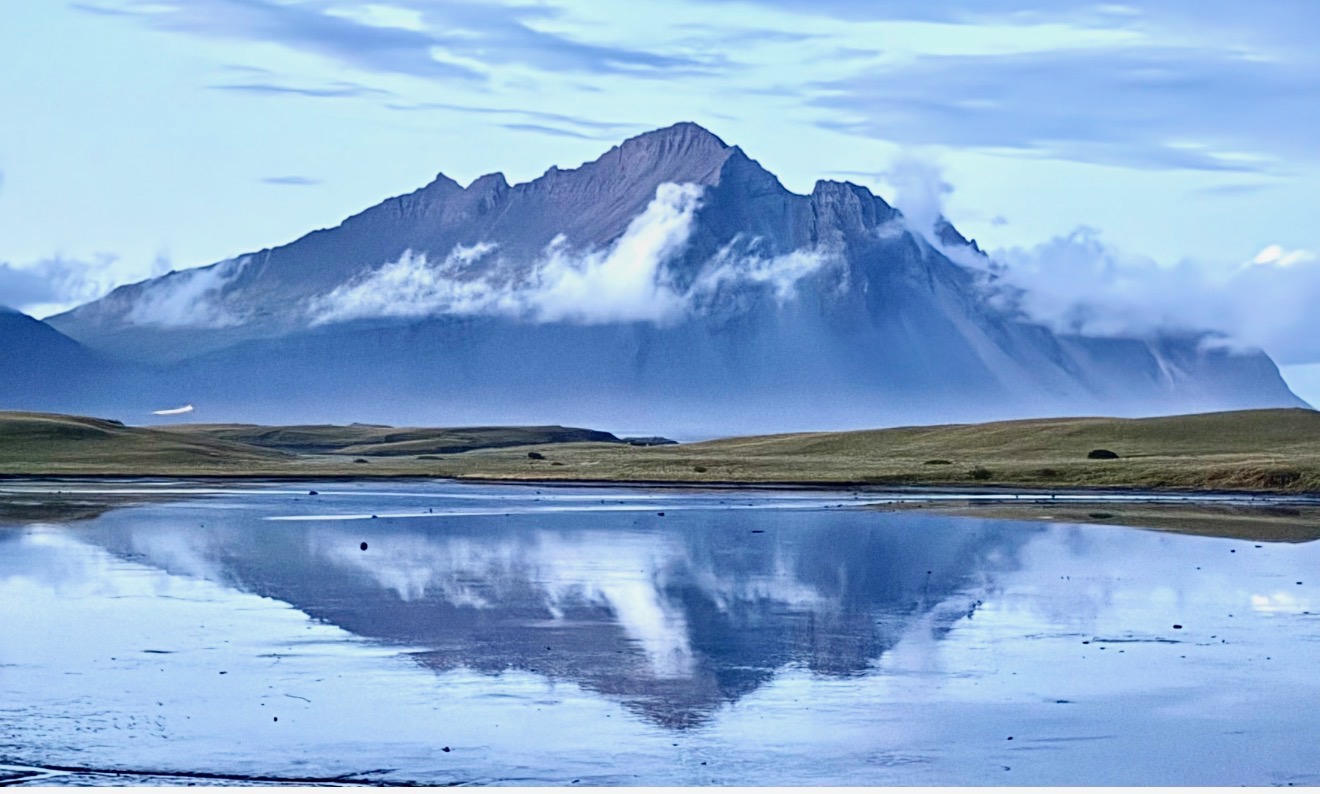
Our Iceland Ring Road campervan trip gave us its first warning before we had technically even arrived in Iceland.
Flying from Canada toward Keflavík took us over the lower edge of Greenland, and from the airplane window it looked less like somewhere people lived and more like an uninhabitable moon. High peaks broke through the white, with frozen rivers and pools trapped between them. Then Iceland appeared, somehow looking like the next planet over, one humans had only recently started terraforming.
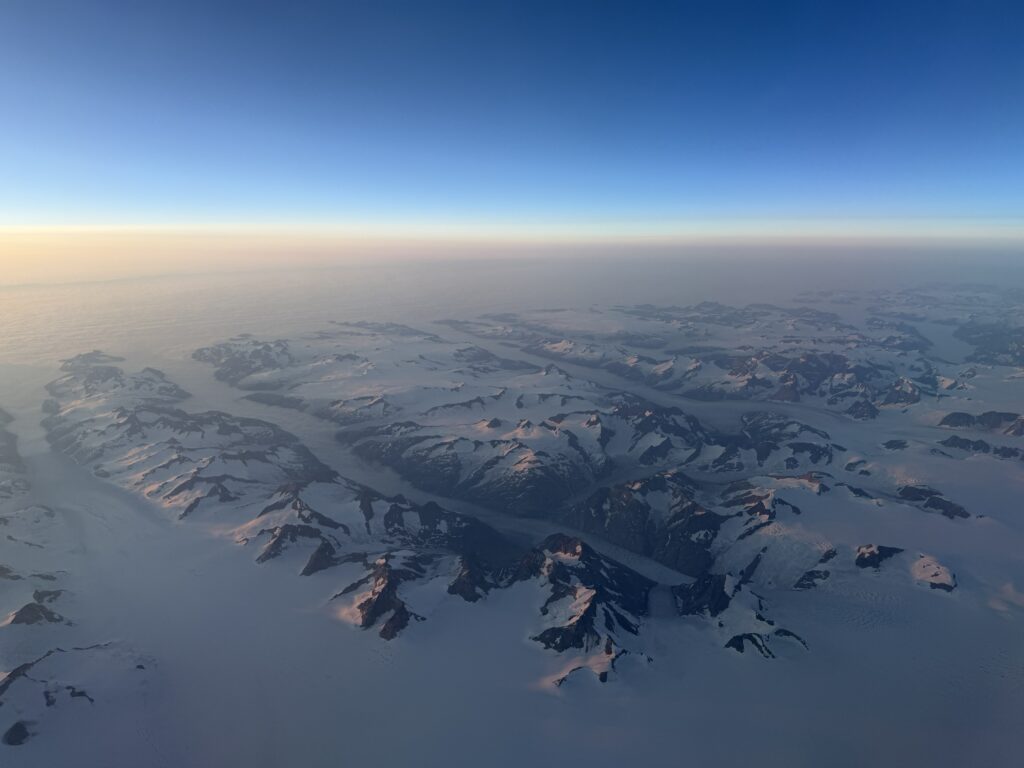
That impression would become difficult to shake as our Iceland Ring Road campervan trip got underway.
Before going any further, there is something I should explain about the Icelandic place names that follow. I did not remember any of them. I had to write them down. After several days of trying to pronounce them correctly, I developed a theory about the Icelandic language. To achieve proper pronunciation, you need to be standing on the deck of a vessel crossing an ocean in subzero temperatures until your jaw starts rattling uncontrollably. At exactly that moment, try saying Kirkjubæjarklaustur. I believe you’ll be close.
We landed at Keflavík, despite Reykjavík being the name most travelers associate with arriving in Iceland. At border control, the officer stamped our passports and asked the usual question.
How long are you staying?
We gave him our departure date.
He stopped. His eyes opened a little wider.
“What are you guys going to do all that time?”
This was not the reaction I expected from the person officially welcoming us into the country.
We explained that we had rented an RV and planned to travel around Iceland. His next question was more specific.
Which route?
“Depends on the weather.”
That answer apparently restored his faith in us. He looked satisfied, finished stamping the passports, and sent us on our way.
We hadn’t even picked up the RV yet, and Iceland had already given us some useful advice: plans here are suggestions. Weather gets the final vote.
Iceland Ring Road Campervan Trip: Höfn and the Eastward Turn
We had researched phone service before the trip and decided not to buy Icelandic SIM cards. Our Italian phones would work there, so there seemed little reason to complicate things.
This immediately complicated things.
We called the RV company for the shuttle.
No answer.
The problem, we eventually realized, wasn’t the phone service. They were expecting customers from the United States, not a call arriving from an Italian number. Apparently the possibility that someone in Italy might telephone a business with a question had not made it into the day’s contingency planning.
After a couple of WhatsApp messages, we finally connected and got to the RV rental place.
There we met our home for the next part of the trip.
It had a cable issue.
This cable would spend the entire journey hanging from the back of the RV, following us around Iceland like an unwanted tail. It became one of those things that initially seems like it should be addressed immediately, then slowly becomes part of the vehicle’s personality.
While they dealt with things, the rental company lent us another vehicle so we could go buy groceries nearby.
This was also our introduction to Icelandic prices.
Nothing eases you into a vacation quite like standing in a grocery store staring at ordinary food as though you’ve accidentally wandered into an auction.
Iceland is expensive. We knew this before arriving. Knowing it intellectually and standing there preparing to pay for things are two different experiences.
And the expenses don’t end at food.
One of the strange things about traveling around Iceland is that so much of what you actually came to see is simply there. Waterfalls, black beaches, mountains, canyons, glaciers. You aren’t buying a ticket to look at the landscape. But your vehicle needs somewhere to sit while you’re looking at it, and that is where the meter starts running.
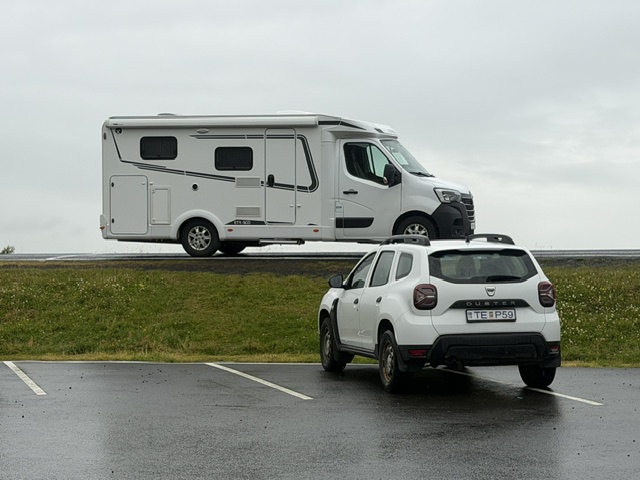
Parking at many of the places we visited was around $11. That doesn’t sound catastrophic until you think about how many places you can stop at in a single day on the Ring Road. Then at night, the RV campground could run roughly $45 to $56.
Do the math.
Then do it again tomorrow.
Groceries loaded, we returned and did the RV inspection. The rental lady also explained something that would become important over the coming days: the difference between an off-road and what she called a dirt road.
This distinction sounded perfectly reasonable while standing in the rental lot.
Later, while our kidneys were being tenderized somewhere in the Icelandic countryside, I would reconsider the terminology.
Counterclockwise, Because the Weather Said So
We checked the forecast and decided to drive the Ring Road counterclockwise, starting along the South Coast.
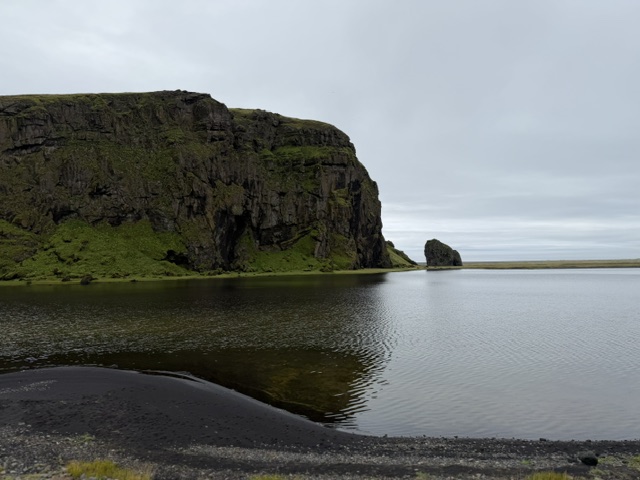
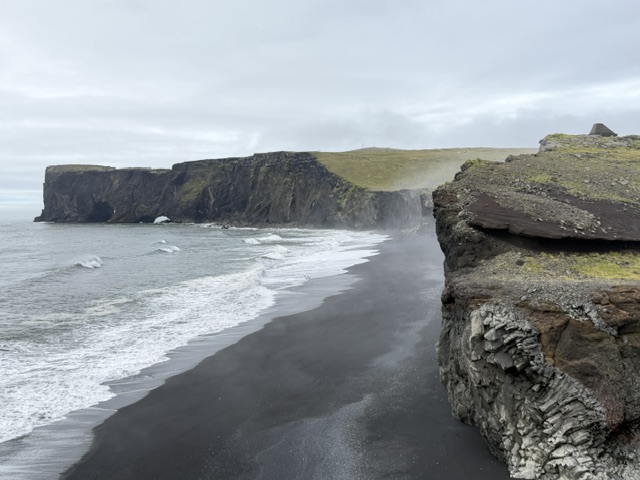
The first mission was simple. Get away from the city.
There was a solar eclipse that day, and we wanted to be somewhere open enough to see it. We raced out toward the countryside with the optimistic belief that Icelandic weather might cooperate with our astronomical schedule.
Along the way we were introduced to another feature of driving in Iceland: sheep.
Sheep and lambs roam freely, often close enough to the road to make you question their understanding of traffic. They watch an approaching vehicle with the calm expression of an animal considering whether today might be a good day to test the brakes on a rental RV.
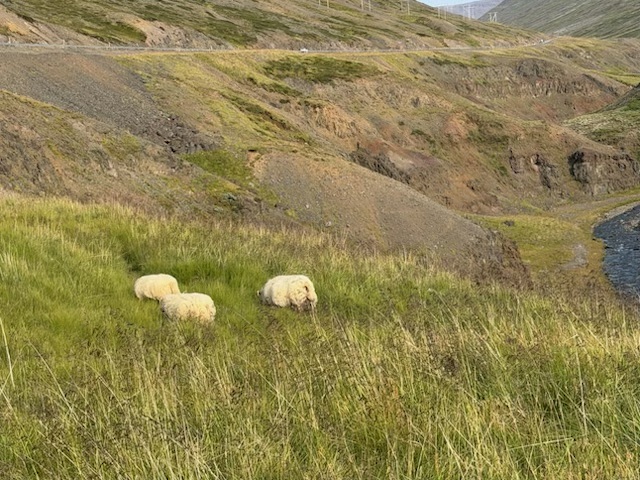
Every encounter becomes a small game of chicken.
Is it staying there? Is it crossing? Does it know we’re coming? Does it care?
The sheep rarely appear concerned.
We were.
Eventually the time for the eclipse arrived.
The sky was completely overcast.
Of course it was.
We pulled the RV onto the side of the road and got out anyway. Darkness arrived, and then the light slowly began returning. Somewhere above those clouds, presumably, there was a spectacular celestial event taking place.
For us it was more of a guessing game.
“There it is.”
Probably.
Still, standing beside an RV in Iceland while daylight disappeared in the middle of the day wasn’t exactly a wasted experience. Sometimes nature doesn’t care that you traveled thousands of miles and checked the calendar.
You get what you get.
Then came the dirt road.
Iceland Has an Interesting Definition of “Dirt Road”
At some point we left the pavement and encountered one of those roads the rental company had explained to us.
Calling it a dirt road was technically accurate in the same way you could technically describe the Atlantic as damp.
It looked as though someone spent weekends driving a 25-ton military tank up and down it for recreation. Deep, continuous tracks ran along the road, and the RV reacted to every one of them.
Everything rattled. The cabinets rattled. The contents rattled. We rattled.
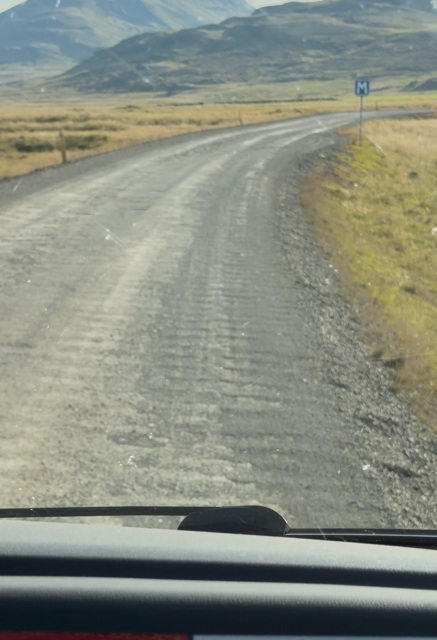
The entire vehicle seemed to be conducting a structural test that nobody had requested.
My only consolation was that if either of us had arrived in Iceland with kidney stones, there was a reasonable chance they were now powder.
This was our transportation, our bedroom, our kitchen, and our home for the road ahead.
And this was only the beginning.
Vík, the Science of Choosing a Campsite
Eventually we reached the Vík and South Coast area, where we stayed at Farmhouse Lodge.
My previous experience with RV parks had been fairly straightforward. You rent a space, you’re assigned a number, and that space has the connections intended for your vehicle.
Iceland had another system.
You paid per person and, if you wanted electricity, paid for that too. Then you found yourself an empty place to park and attempted to connect your RV to whichever electrical stand happened to be within the same postal code.
Then came the more complicated matter of selecting the perfect parking spot.
My copilot had, by this stage, earned the nickname Goldilocks.
She even had an iPhone level app to help with the decision, which transformed parking the RV from a simple act into a small surveying operation.
One spot had the wrong slope according to the phone. Another had the wrong view. Another apparently failed some invisible test known only to her.
We moved.
Then moved again.
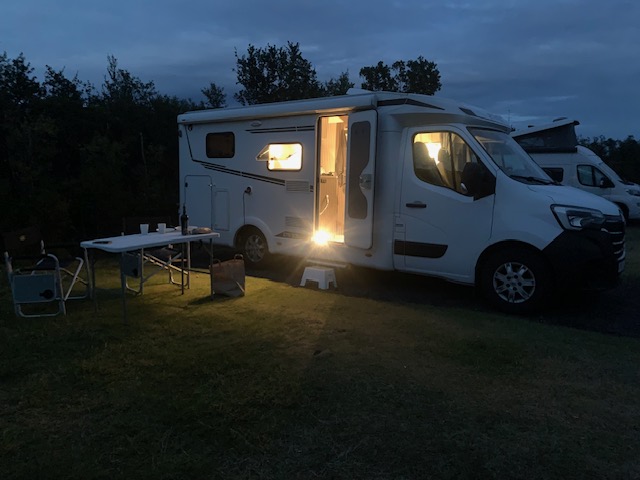
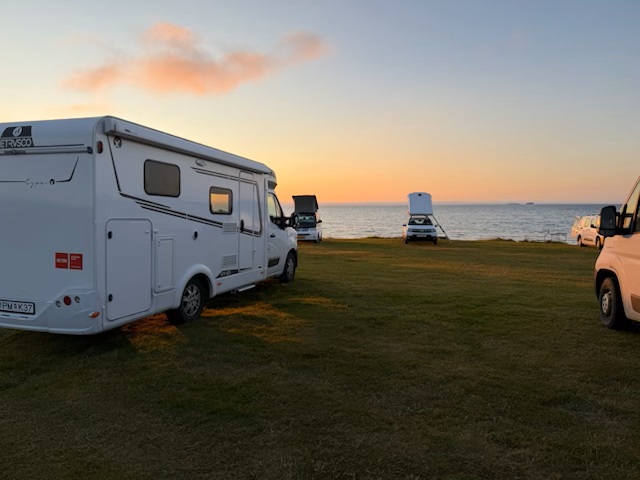
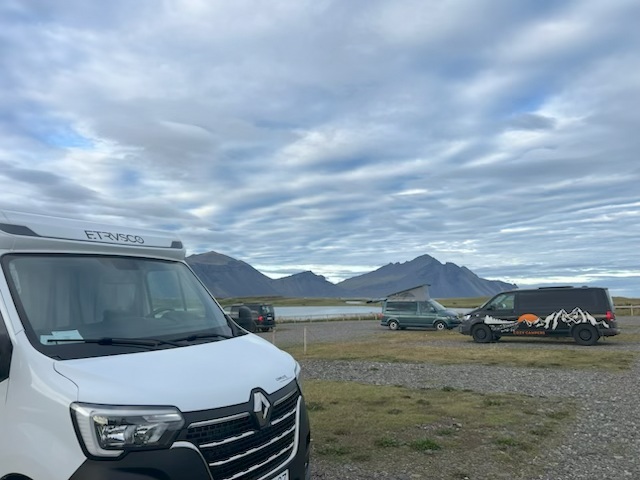
The iPhone came out. The level was checked. Adjustments were made. Choosing an RV spot became a mixture of slope calculations, scenery, technology, intuition and pure guessing. If the final location still wasn’t “just right,” somehow the chain of responsibility eventually worked its way back to me.
At Farmhouse Lodge, our cord wasn’t long enough, so they provided extra extensions. I ran them across the wet, muddy ground until we finally reached power.
Dyrhólaey and Our First Puffins
The South Coast began delivering the Iceland we had come to see.
We visited Dyrhólaey and saw puffins there, the first of several wildlife experiences that would eventually include minke and humpback whales later in the trip. We explored around Vík and Reynisfjara and visited Gígjagjá, better known as Yoda Cave because of the shape created by its opening.
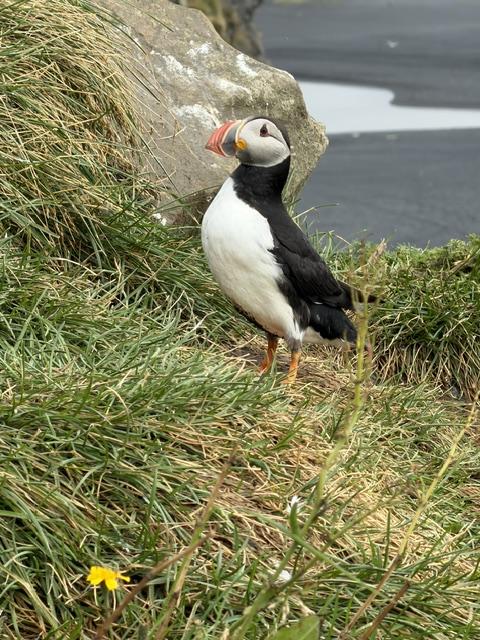
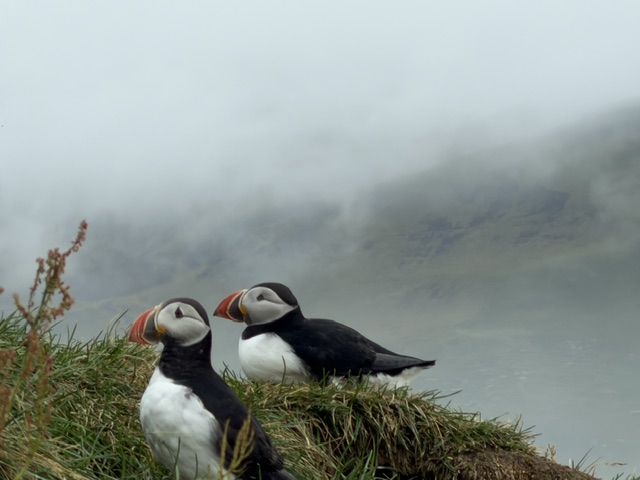
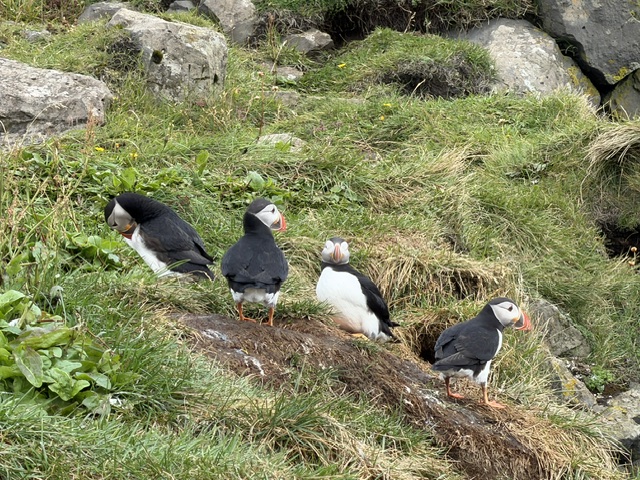
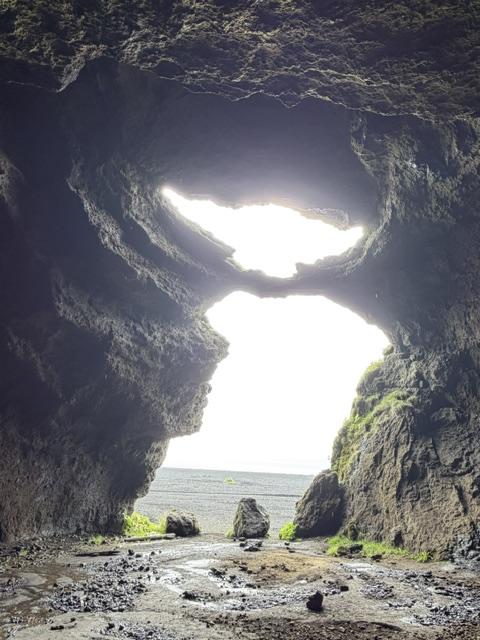
The landscape had the same unfinished quality I had noticed from the airplane. Black volcanic ground, ocean, cliffs, lava and enormous empty spaces seemed to collide without much concern for whether they belonged together.
Then there was pizza.
Pizza is everywhere in Iceland.
Restaurants have it. Menus have it. It follows you around.
There is a practical explanation from a traveler’s perspective: eating out in Iceland is expensive, and pizza becomes one of the easier ways to sit down for a meal without immediately reassessing your retirement plans.
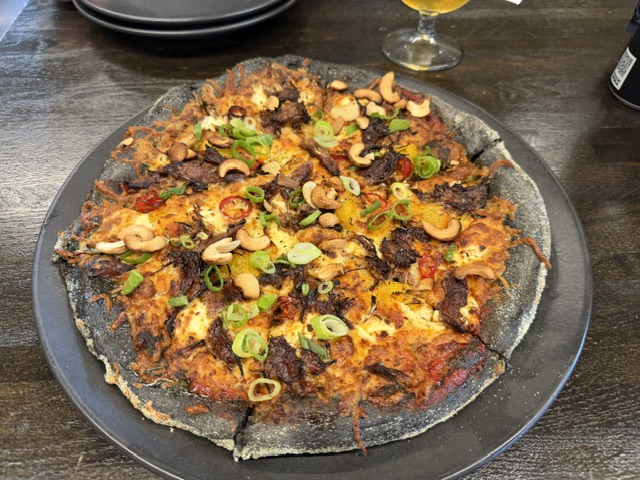
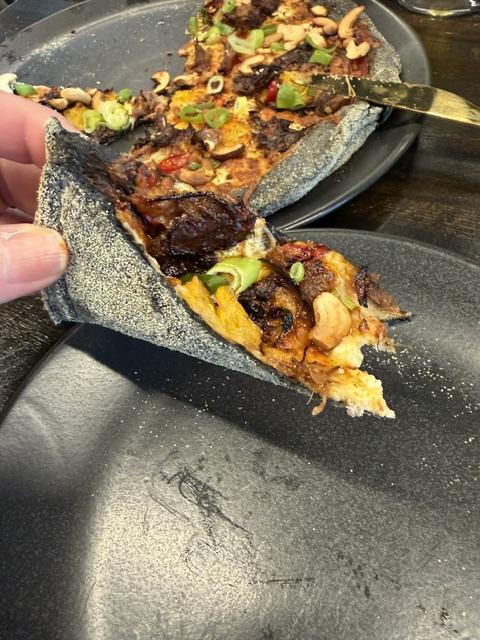
We eventually tried Black Crust Pizzeria in Vík.
Their signature was black pizza made with activated-charcoal dough, visually connected to Iceland’s black volcanic beaches. We ordered ours with duck.
Black Icelandic pizza with duck was not necessarily the meal I imagined before the trip.
But here we were.
And it worked.
From Lava Fields to a Glacier
Leaving the Vík area, we continued east through the South Coast toward Kirkjubæjarklaustur, stopping at Fjaðrárgljúfur Canyon and driving through the enormous lava fields.
If you’re wondering how to pronounce either of those names, please refer back to my subzero vessel theory.
Iceland has a way of destroying your sense of scale. A landscape can look empty until you realize you’ve been driving through the same geological feature for an uncomfortable amount of time.
Then we reached the Skaftafell and Vatnajökull area.
This time, instead of looking at the landscape through the windshield, we went onto it.
We joined a Tröll Expeditions glacier tour and walked on Vatnajökull.
There is something strange about standing on a glacier after spending days driving through a country where almost everything already looks slightly unreal. You have spent hours seeing ice in the distance, mountains disappearing into clouds and water cutting through black ground. Then someone puts you physically on top of the ice.
The scenery stops being background.
You’re standing on it.
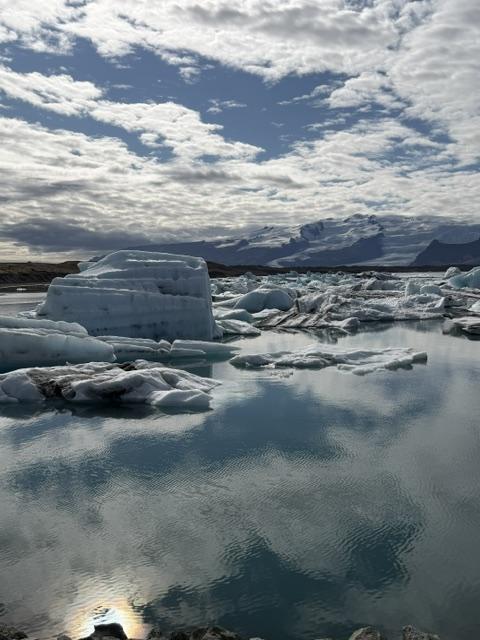
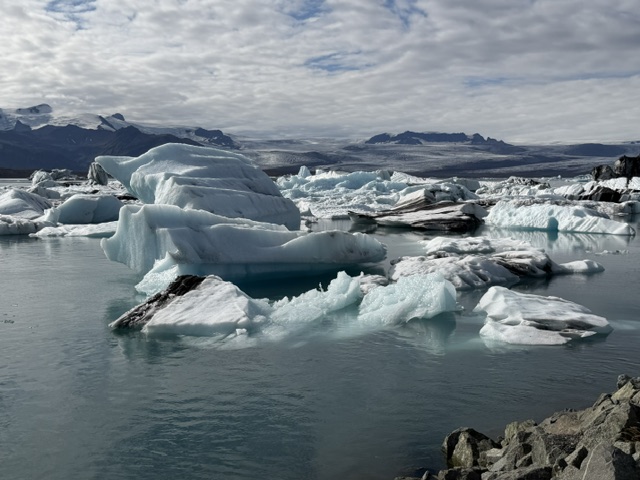
From there we continued to Jökulsárlón Glacier Lagoon, where icebergs broken from the glacier drift through the water before eventually making their way toward the ocean.
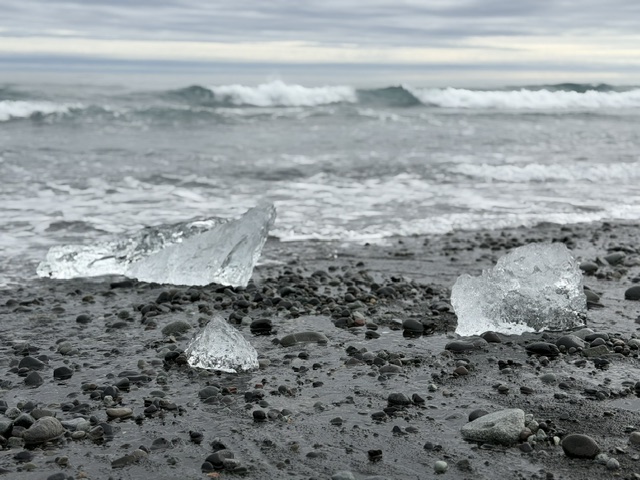
Nearby, we walked Diamond Beach, where pieces of ice end up scattered against black sand.
Ice on black volcanic beach shouldn’t look normal.
After a few days in Iceland, somehow it does.
Höfn and the Eastward Turn
We continued to Höfn, camped there and tried the local langoustine before moving on toward Stokksnes and Vestrahorn.
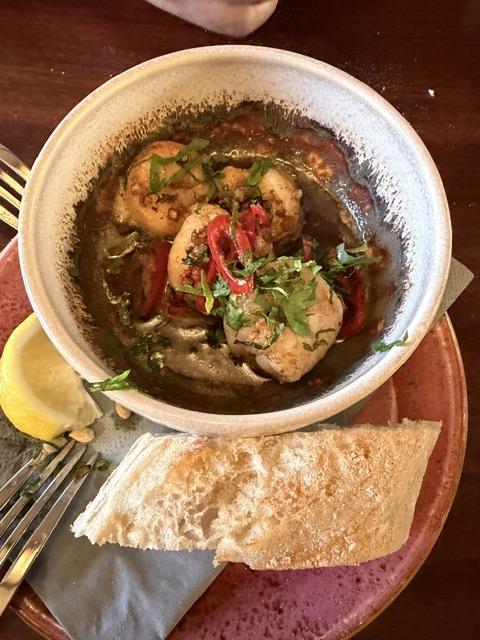
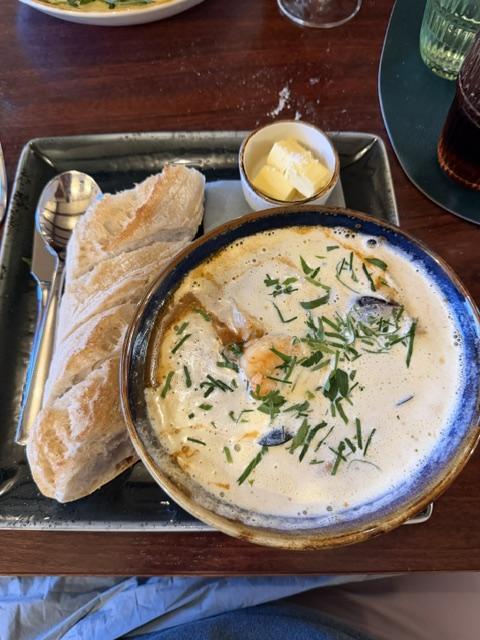
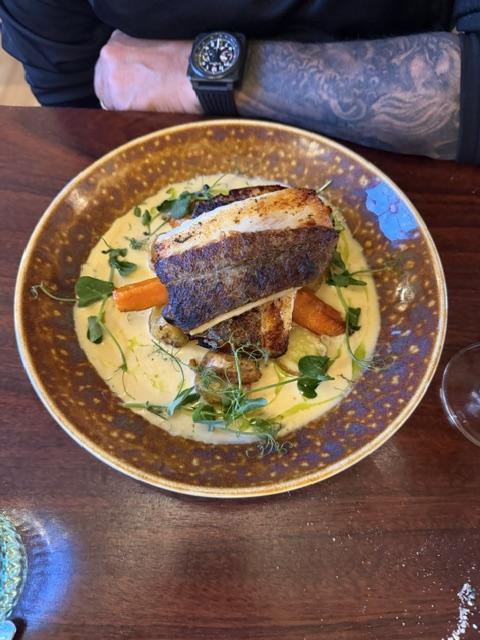
At Vestrahorn we explored the black-sand coastline and visited the Viking Village film set. The combination felt appropriately Icelandic: dramatic mountains and black coast outside, reconstructed Viking history nearby, and an RV waiting for us somewhere in the background with a cable still hanging from its rear.
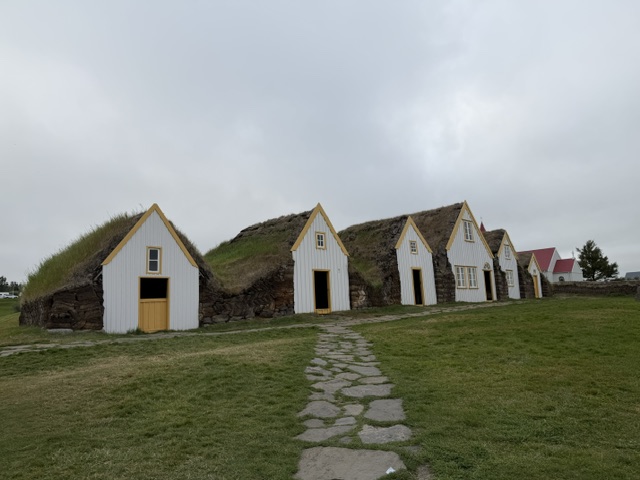
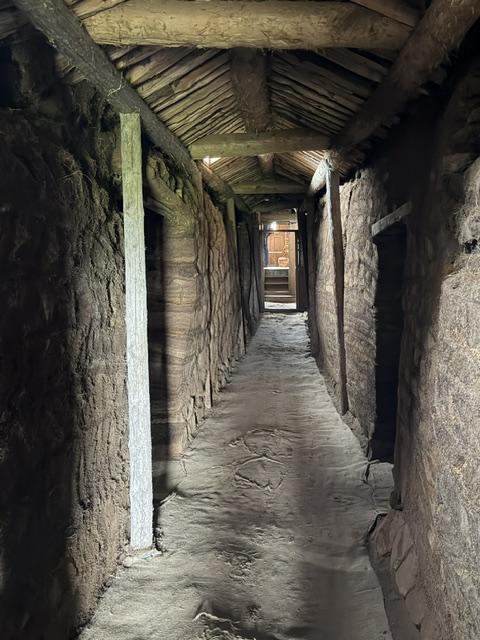
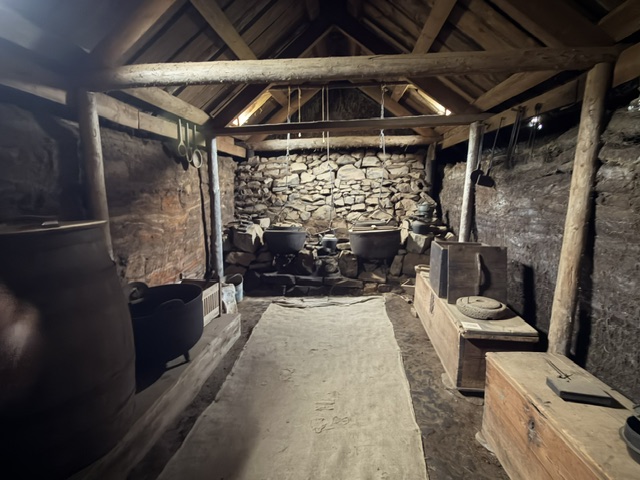
From there we stopped around Hvalnes and saw Eystrahorn before continuing along the increasingly remote eastern coastline.
Fauskasandur brought more black sand and isolation.
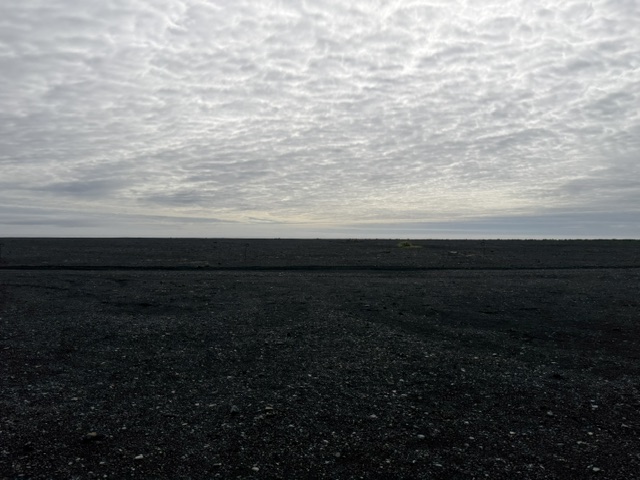
Then came the East Fjords.
At first, the drive was spectacular.
Mountains rose beside the road, water opened below us, and settlements became increasingly scarce. It was exactly the kind of drive that makes you slow down simply because there is too much to look at.
Then the road changed.
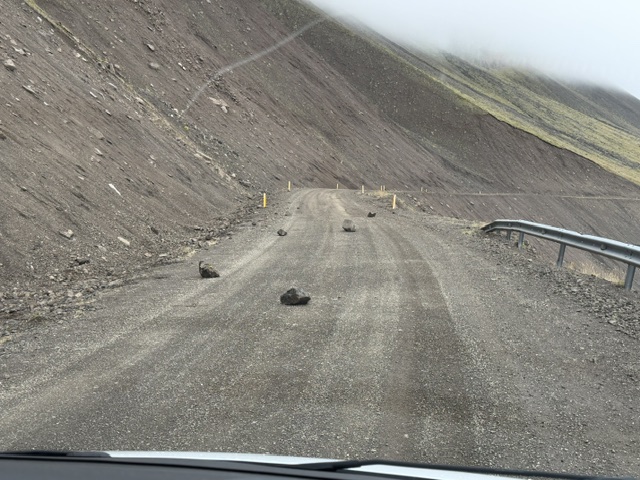
To our left was a steep mountain. To our right was a drop toward the water.
Between them was us.
In an RV.
On a dirt road.
And apparently the mountain had recently decided to contribute several enormous boulders to the driving surface.
So now we had an obstacle course.
The relaxed scenic drive through the East Fjords became something considerably more focused. There are moments when a beautiful landscape deserves contemplation. There are other moments when the mountain is on one side, the precipice is on the other, and your primary interest in nature is making sure none of it enters the RV.
We made it through, continued around Djúpivogur and Berufjörður, hiked to Nykurhylsfoss/Sveinsstekksfoss in the Fossá area, and eventually camped at CampEast in Breiðdalsvík.
By then Iceland had established the rhythm of the trip.
Drive. Stop. Walk. Stare at something enormous. Pay to park. Drive again. Try not to hit a sheep. Find somewhere to camp. Pay again. Negotiate with Goldilocks and her iPhone over whether the RV is level. Repeat.
We were driving as much as twelve hours a day while stopping to see places along the route, which meant the RV wasn’t simply transportation anymore. It was the center of the trip.
That would become particularly relevant when we reached East Iceland and Vök Baths.
Because after days of glaciers, waterfalls, black beaches, lava fields, sheep, questionable roads and long hours behind the wheel, I made a radical decision.
I was going to take a nap.
It lasted just long enough for part of the RV to fall off.
To be continued in Part 2.